
 Buy now, Pay later

Why Mattress Edge Support Matters for Comfort and Everyday Use
Could a mattress feel comfortable in the middle yet unstable when you sit on its edge? That’s why mattress edge support importance goes beyond technical wording in a product description. If you worry about feeling as though you might roll towards the side, or regularly sit there to get dressed, the mattress perimeter can make a real difference to everyday comfort.
Edge support describes how well a mattress holds its shape around the sides. The right level depends on how you sleep and use your bed, so there isn’t one answer for everyone. We’ll explain how different designs may feel, who may value a steadier edge and which simple checks can help you assess a mattress. Sitting on the edge and lying near the perimeter are useful tests, and trying them in person at our Cambridge showroom can complement reading the specifications.
We offer interest-free Klarna payments on purchases up to £1000, spread over 3 months.
Key Takeaways
- The importance of mattress edge support depends on your routine, including whether you sit on the side or sleep near the perimeter.
- Foam encasement, reinforced springs and steel rods are examples of ways manufacturers may strengthen a mattress edge.
- Compare construction and how the perimeter feels rather than assuming one mattress type always has the best edge support.
- Test the edge and centre in the positions you expect to use, and notice how stable and comfortable each feels.
- Weigh edge feel alongside comfort, firmness and sleeping space so one feature doesn’t overshadow how the whole bed feels.
What mattress edge support is and how it affects everyday comfort
Edge support is the resistance a mattress perimeter provides under pressure. In practical terms, it describes how the outer sides respond when you sit, lie or lean near them. The importance of mattress edge support depends on how often you use that area and how it feels to you, not on a label alone. A mattress may feel supportive across its central sleeping surface but give a different sensation at the sides.
What does mattress edge support mean?
The perimeter is simply the mattress’s outer boundary. Its construction varies, so the edge may feel firmer, softer or similar to the centre when weight is applied. Edge support refers to that response, rather than the mattress’s overall firmness or the support it provides beneath your body while you sleep.
That distinction helps you interpret product descriptions. A firm-feeling sleeping surface doesn’t automatically mean the sides will feel equally steady. Likewise, a softer edge doesn’t tell you how comfortable the centre will feel. For a general overview of mattress construction and types, it helps to consider the perimeter as one part of a mattress’s broader design.
When might edge support matter in daily use?
Think about your usual routine. If you sit on the side to get dressed, put on shoes or settle before lying down, you may notice whether the edge compresses under you. When getting into bed, you might also prefer a perimeter that feels steady as you shift your weight. These are practical preferences, not promises of better sleep.
- Sitting at the side: Notice whether the edge feels comfortable and stable for your usual task.
- Using more of the width: If you sleep close to the side or share the bed, the perimeter may feel more noticeable than it does for someone who stays near the centre.
- Getting in and out: Pay attention to how the mattress responds as you sit down or move your weight across it.
People who use the full width may value a consistent feel from the centre towards the sides. If you tend to sleep centrally and rarely sit on the bed’s edge, this feature may be less prominent in your decision. Neither routine makes a particular edge feel right for everyone. Body shape, preferred sleeping position and personal comfort all influence what feels suitable.
Treat edge support as one part of choosing a mattress, alongside comfort, firmness and personal fit. A steadier-feeling perimeter can suit certain habits, but it can’t guarantee improved rest. The useful question is whether the mattress feels comfortable across the areas you actually use, including its edge.
How mattress edge support systems create a steadier perimeter
Manufacturers can shape a mattress perimeter in several ways. Some designs use firmer foam around the core, while others adapt the springs or add a metal component at the edge. These are construction examples, not features found in every mattress. Knowing the terms can help you understand a description, but it won’t tell you exactly how the finished mattress will feel under your weight.
The importance of mattress edge support lies in how the design works for your needs, not in the name of a component. A reinforced perimeter is intended to address pressure at the sides, but your experience also depends on the comfort layers, spring or foam core, firmness and the mattress as a whole. No single method guarantees a particular feel or a longer-lasting mattress.
Foam-encased and reinforced-spring edges
With foam encasement, firmer foam surrounds the mattress core to form a more structured border. In a spring design, the perimeter may instead use reinforced springs intended to resist pressure at the sides. These approaches can be used in different mattress constructions, but the terms don’t mean every foam or pocket-sprung model has the same edge design.
Descriptions may also use phrases such as “foam border” or “reinforced perimeter”. Treat them as clues about construction, not a guarantee of how the edge will feel when you sit or lie there.
Steel rods and other perimeter designs
A steel rod is another example mentioned in discussions of mattress edge construction, particularly alongside traditional spring designs. Its presence describes a component, not a promised level of comfort or durability. Other models may rely on their existing materials and structure rather than a separate perimeter feature.
Construction language is most useful when you pair it with a practical comparison. If a specification names an edge system, consider what it’s designed to do, then assess the mattress itself. A term alone can’t account for how all the layers work together.
For wider context, the International Sleep Products Association provides information about mattress industry standards. This offers background on the industry, but it shouldn’t be read as a rating of how supportive a particular mattress edge feels. For that, construction details and your own experience both matter.
Try not to treat any one material as an automatic winner. Two mattresses with similar perimeter descriptions can still feel different because their full designs differ. In our Cambridge showroom, you can compare mattress edges in person and see how construction notes relate to the feel under you. That hands-on check is useful alongside reading the specifications.
Comparing edge support across mattress designs without assuming one winner
Mattress categories offer a useful starting point, but they can’t tell you exactly how a particular edge will feel. Spring, hybrid and foam designs use different core materials, and manufacturers may add perimeter features to some models but not others. Compare the stated construction with how the mattress feels in person, rather than relying on the category name alone.
How pocket-sprung, hybrid, and foam designs may differ
Pocket-sprung mattresses use individual springs within the core, hybrids combine springs with other comfort materials, and foam designs use foam for their core and comfort layers. Those differences can influence how pressure is distributed, including near the sides. But construction varies between mattresses, so none of these broad labels guarantees a particular edge feel or suits every sleeper.
| Broad construction | What the edge may feel like | What to explore in person |
|---|---|---|
| Pocket-sprung | The response can vary with the spring unit, comfort layers and any perimeter design. | Does the edge feel different from the centre when you sit or lie near it? |
| Hybrid | Feel depends on how the spring core and other materials work together. | Does the perimeter feel comfortable for your usual position and routine? |
| Foam | Foam can respond to pressure differently depending on its type, layers and construction. | How does the side respond compared with the middle under your weight? |
| Latex | The overall response depends on the materials and complete mattress design. | Does the surface feel supportive and comfortable across the area you use? |
Use the table as a prompt, not a ranking. Mattress edge support importance is best judged against your own preferences and the specific construction details available. For example, two pocket-sprung mattresses may have different comfort layers or perimeter designs, so their sides may not feel alike. Our Hypnos mattress range and Sealy mattress range are options to compare, without assuming either brand has one edge feel across every model.
Why firmness and edge support are not the same thing
Firmness describes the overall feel of a mattress, while edge support refers specifically to how its perimeter responds to pressure. A mattress may feel comfortable and suitably firm across the sleeping surface, yet have sides that feel softer or firmer by comparison. Try both areas, and consider how the whole surface feels for your preferred sleeping position, not just a firmness label or edge description.
In our Cambridge showroom, trying different mattresses in person can help you connect construction descriptions with their feel. Notice the centre and sides, then consider whether each mattress suits the way you sleep and use your bed. The most useful comparison balances comfort across the whole surface with the edge feel that works for your routine.
How to assess mattress edge support for your own routine
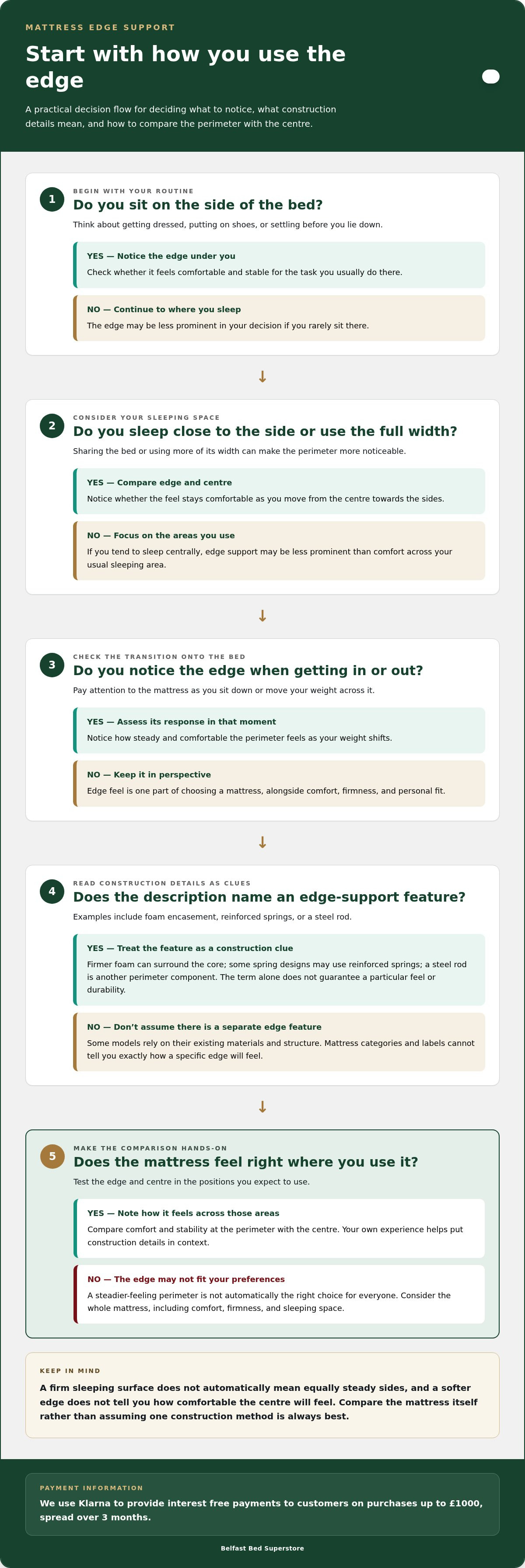
A useful edge test is simple, but it should reflect what you actually do in bed. The importance of mattress edge support varies with your routine, so compare mattresses in the same way rather than relying on a quick sit or a product description alone. In a showroom, you can judge the immediate feel. That try-out can’t predict every night at home, where your usual sleep position and habits shape the experience.
What to notice when sitting and lying near the edge
Start with the activities you want the mattress to handle. Sit briefly on the side as you might while dressing, then lie near the edge in a natural sleeping position. Notice whether each position feels comfortable and steady, and whether the edge feels noticeably different from the centre. There’s no need to exaggerate the test by leaning or bouncing.
Match the test to how you use your bed
Consider whether you sleep alone or share the surface, whether you tend to settle near the sides, and how you get in and out of bed. If you often sit on the edge to get dressed, include that in your comparison. For broader mattress-choice factors, our Sealy mattress buying guide offers related reading.
- Identify your routines. Think about sitting to dress, getting into bed, sharing the sleeping surface and your usual sleeping positions. Focus on the moments when you expect to use the perimeter.
- Test the edge. Sit briefly on the side with your feet positioned as they would be at home. Notice whether the surface feels comfortable and how much it gives under you.
- Lie near the perimeter. Settle into a natural position close to the side. Check whether you feel at ease, then shift into another position if that’s part of your normal sleep routine.
- Compare the centre and reflect. Lie in the middle, then compare the sensation with the edge. Repeat the same checks on another mattress and consider which differences matter for your habits.
Keep the comparison consistent. Use the same sitting position, lie in a similar way and pay attention to the same details on each mattress. That makes it easier to distinguish a meaningful difference from a first impression. Your notes can be as simple as “comfortable at the side” or “centre feels different”.
A showroom visit is a helpful way to compare mattress edges in person, including at our Cambridge showroom, but a short test isn’t a guarantee of how a mattress will feel through every night at home. Use what you notice alongside comfort across the full surface, your preferred firmness and the product’s construction details.
Compare mattress edges in person at our Cambridge showroom and see how different options feel under you.
Choose a mattress by balancing edge feel with whole-bed comfort
Edge support is worth assessing, but it shouldn’t decide your mattress choice on its own. The importance of mattress edge support depends on how you use your bed, while lasting comfort comes from how well the whole mattress suits your body and preferences. Keep the perimeter in view, but weigh it alongside firmness, sleeping space and the feel of the central surface.
A practical shortlist before deciding
Before comparing options, note what matters most in your everyday routine. If you share the bed or tend to sleep near the side, the usable width may be a priority. If you sit on the edge regularly, consider how comfortable it feels for that task. These preferences give your assessment a purpose and help you avoid choosing on one specification alone.
Use the same checks for each mattress. Pay attention to the centre and the edge, and note where each one feels comfortable or different. Then look at the construction details to understand what the description tells you, without treating a label as a substitute for how the mattress feels.
- Comfort: Does the whole surface feel inviting in your usual sleeping position?
- Firmness: Does the overall feel suit your preference?
- Sleeping space: Is there room for the way you sleep, alone or with a partner?
- Edge feel: Does the perimeter feel comfortable for sitting or lying near it?
- Construction: Do the details help explain the feel you noticed?
A mattress that feels supportive at the edge may still not be the right fit if the rest of the surface feels uncomfortable. Equally, a comfortable mattress doesn’t need to have the edge feel you expected from a category name. Use your notes to balance these factors, rather than letting one feature outweigh your overall impression.
Try mattress options in Cambridge
Reading descriptions is helpful, but comparing options in person adds another perspective. Our Cambridge showroom has over 100 beds across over 20,000 sq ft of space, giving you the opportunity to experience different mattress feels side by side. Our experienced staff can help you compare options and make sense of the details, without assuming a particular design will suit everyone. We welcome customers from across Cambridgeshire and East Anglia.
Take your shortlist with you and focus on the features that matter to your routine. A relaxed, consistent comparison can help you decide whether the edge feels right without losing sight of comfort across the whole bed.
Browse the range at Belfast Bed Superstore.
Make your next mattress choice with confidence
Let your own comfort guide the decision. Mattress edge support importance becomes clearer when you think about how you use your bed, but it should stay in balance with the feel of the whole sleeping surface. Give yourself room to compare, notice what feels right and choose based on your routine rather than a single label.
At Belfast Bed Superstore, we’ve been established since 1905, and our team is here to help make mattress choices more straightforward. If you’re ready to explore options, compare how they feel in our Cambridge showroom, serving customers across Cambridgeshire and East Anglia.
Explore mattresses at Belfast Bed Superstore and find a comfortable fit for your everyday life.
Frequently Asked Questions
Is mattress edge support important for everyone?
Not to the same degree. It may matter more if you perch on the bed to pull on socks or sleep close to its outer side. If you usually stay centred and rarely sit on the mattress, edge feel may be lower on your shortlist. Understanding mattress edge support importance starts with these habits, then comparing them with how comfortable your body feels across the sleeping area.
Can mattress edge support stop you rolling out of bed?
No. Edge support isn’t a barrier, and it can’t guarantee that you won’t roll out. Your position, mattress size and movements during sleep all play a part. If you often shift towards the side, consider whether the mattress feels comfortable and steady there, but judge support across the full surface too. Choose a size and feel that suit your sleeping habits rather than relying on the perimeter alone.
Does a firm mattress always have better edge support?
No. Firmness describes the general feel of the mattress, while edge support describes how its perimeter responds to pressure. For example, you might find the middle of a mattress comfortably firm but notice that the side feels different as you sit down. Don’t treat a firmness label as a guide to the edge. Try both areas, and consider whether the overall feel suits your preferred sleeping position.
How can I test mattress edge support in a showroom?
Sit briefly on the side and notice whether it feels comfortable and steady. Then lie near the perimeter in a position you’d naturally sleep in, and compare that sensation with the middle. Repeat the same movements on other mattresses to make the differences easier to judge. A visit to our Cambridge showroom can help you compare in person, though a short try-out can’t recreate every night at home.
Does edge support make a mattress feel larger?
It doesn’t change the mattress’s actual dimensions. However, if the perimeter feels comfortable to you, more of the surface may feel usable. This can be worth considering if you share the bed or tend to sleep near the sides. Think about your usual position and compare how the edge feels with the centre before deciding whether that sense of usable space matters for your comfort.
Can mattress edge support wear out over time?
Mattress materials and construction can change with use, but the way an individual edge performs over time depends on the mattress and its care. A particular construction feature isn’t a promise of a specific lifespan. Follow the maker’s care instructions, and notice whether your comfort changes at the sides, in the middle or across the whole surface. Looking at the overall feel can help you identify what has changed.