
 Buy now, Pay later

How to Choose Mattress Firmness at 15 Stone
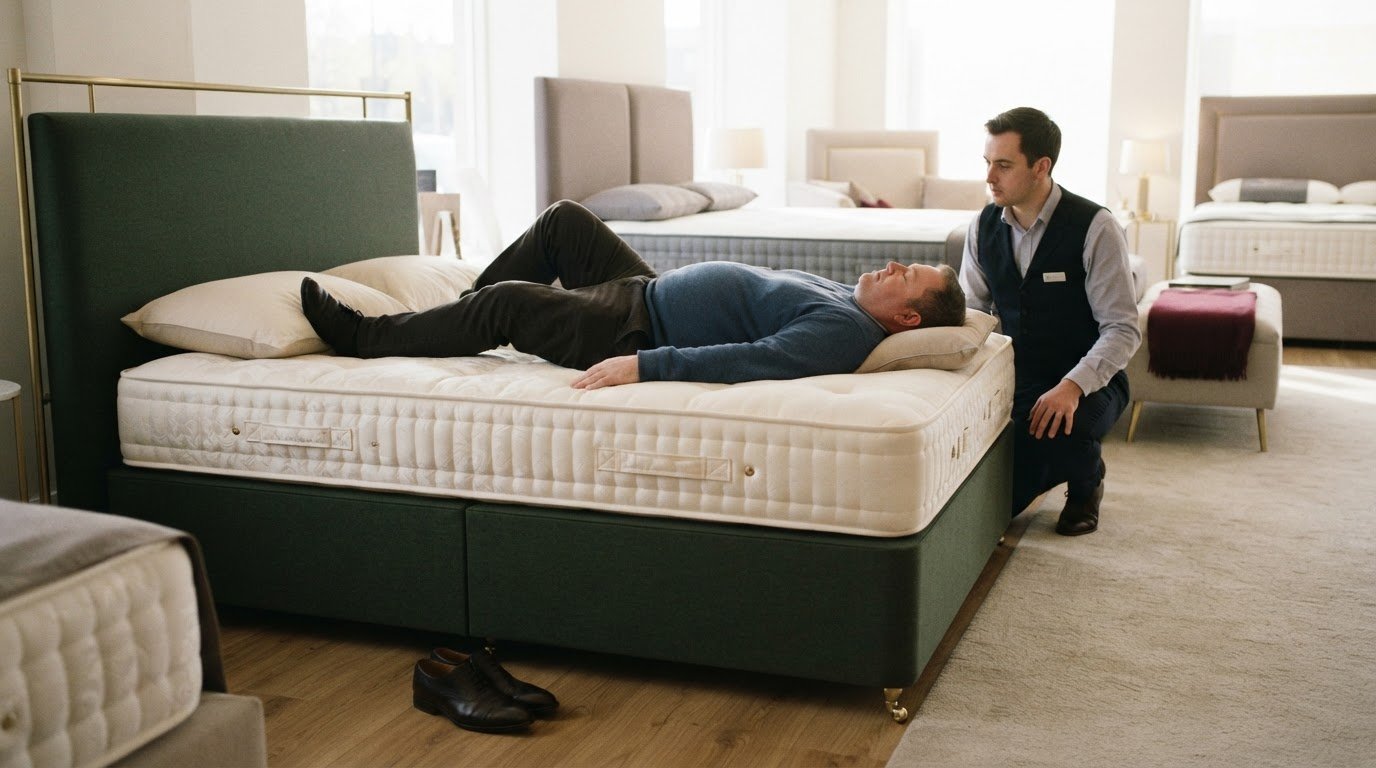
What if the firmness number on a mattress tells you less than you think? If you’re wondering what firmness is best for a 15 stone person, use your sleeping position as the starting point: standard firmness ratings generally apply fairly accurately to sleepers between 11 and 15 stone, but the feel can vary from one brand to another.
It’s easy to assume that a higher firmness rating always means better support. In practice, your mattress needs to support your body and feel comfortable, and the right balance depends partly on your sleeping position. A mattress that feels pleasantly cushioned on your side may feel too soft on your back or front.
This guide explains how to use firmness ratings without treating them as a universal scale. You’ll learn how sleeping position can shape your choice, what may suggest a mattress feels too soft or too firm, and why support isn’t the same as surface firmness. We’ll also explain how brands’ rating differences affect comparisons, so you can judge a mattress by how it feels rather than relying on a number alone.
Key Takeaways
- Use body weight as a starting point, then consider how your height and the way you sleep affect the mattress feel.
- Look for a balance of cushioning and support rather than assuming the firmest mattress is automatically the best choice.
- Use your sleeping position to narrow down firmness options, while allowing for your personal comfort preferences.
- Compare how a mattress feels, not just its firmness number, because brands may rate firmness differently.
- Notice whether the surface feels too hard or too yielding, and use that sensation to guide your choice.
What is mattress firmness?
Mattress firmness describes how hard or yielding its surface feels, often on a 10-point scale. At 15 stone, your body shape and sleeping position help explain why the same rating can feel different from one mattress to another.
Body Weight and Perceived Firmness
Body weight affects how far you sink into a mattress, while body shape influences where that weight presses. Standard firmness ratings apply fairly accurately to people weighing 11 to 15 stone, but height still matters: two people weighing 80 kilos may need different spring tensions if one is 5 foot and the other is 6ft 4”. For someone asking what firmness is best for a 15-stone person, weight is a useful starting point, not the only decision.
A mattress that feels firm to one person may feel softer to someone who sinks further into its comfort layers. A 15-stone sleeper should consider whether their body feels level and supported, rather than choosing by weight alone. That balance can help maintain alignment without creating uncomfortable pressure at the shoulders or hips.
How Mattress Materials Affect Feel
Mattress materials shape both the surface feel and the way a bed responds under pressure. Pocket springs compress individually, while foam comfort layers can contour more closely around the body. A medium pocket-spring tension is suited to people weighing 9 - 16 stone, so it falls within the stated range for a 15-stone sleeper.
Partners can have different firmness preferences, even when sharing a bed. Split or dual-tension mattresses provide a different feel on each side, which can help one person choose more cushioning while the other prefers a firmer surface.
To test firmness in a UK showroom, lie in your usual sleeping position and notice how your shoulders, hips and lower back feel. Give the mattress time to settle beneath you rather than judging it from a brief press with your hand. When possible, try a new firmness for 2 to 4 weeks, since a short showroom test may not reflect a full night’s comfort.
Mattress Firmness and Back Pain Signs
Morning back pain that eases within an hour of getting up can be a sign that your mattress contributes to discomfort. Notice whether you wake with soreness repeatedly and whether it improves after moving around. These patterns can help you assess how your mattress feels, although they don’t establish the cause of pain.
Firmness and support are related, but they aren’t identical: a firm mattress can still leave parts of your body unsupported if it doesn’t suit your shape. On a 10-point scale, firmness describes surface feel; alignment describes how your body rests across the mattress. If your back feels strained or your hips sink noticeably, consider whether the mattress provides a better balance of comfort and support.
Firmness recommendations by sleeping position
Your usual sleeping position offers a practical starting point for firmness. At 15 stone, use that position-based guide, then consider whether the mattress lets your body rest comfortably without too much pressure or sinkage.
For UK shoppers weighing over 15 stone, one guide recommends choosing one step firmer than the position-based recommendation. At exactly 15 stone, treat that as a nearby reference, not an automatic rule. A mattress should still feel comfortable in your usual position, with your back and hips supported.
Match Firmness to Your Sleeping Position
Side sleepers often need enough cushioning for their shoulders and hips. Suggested ratings range from 1 to 3 in one guide, while another gives a broader range of 2 to 7. That difference shows why the number is only a starting point. If your shoulder feels pressed, a softer surface may suit you better.
Back sleepers are commonly matched with ratings of 3 to 5, while stomach sleepers are often advised to try 4 to 6. Other guidance places back and front sleepers between 3 and 8. These ranges overlap because body shape, comfort and the mattress itself affect the feeling. If you change position during the night, look for a balance rather than choosing solely for one posture.
Support Options for Heavier Sleepers
For sleepers weighing 16 to 20 stone, firm mattresses are often recommended. People over 20 stone are generally directed towards extra-firm options. For spring beds, a recommendation for heavier UK shoppers is 2000 or more pocket springs; 3000 may be worth considering for heavier sleepers or couples with a large weight difference. Spring count alone doesn’t determine comfort, so consider the overall feel and support together.
There isn’t one mattress type that suits every heavier sleeper. Pocket springs are one option to consider, with spring tension and comfort layers shaping how the bed responds. Some guidance suggests firm to very firm mattresses for heavier sleepers, but a very hard surface may provide little pressure relief. “Orthopaedic” on a label doesn’t replace checking how the mattress feels in your sleeping position.
Weight Limits and Warranties
Mattress weight limits and warranty terms vary by model, so there isn’t one limit or warranty duration that applies to every mattress. The construction and the manufacturer’s terms determine what applies to a particular bed.
Try the mattress in your usual position, paying attention to pressure at your shoulders and hips and whether your middle sinks. A firmer option may feel steadier on your back or front, while a softer surface can ease pressure on your side. Explore mattress options as you narrow down the feel that suits your sleeping position.
Difference between firmness and support
Mattress firmness describes the surface feel, from soft and yielding to firm and resistant. Support describes how well the bed holds your body in a comfortable position. For a 15-stone sleeper, these qualities work together, but one doesn’t guarantee the other.
A firm mattress can still feel unsupportive if it doesn’t suit your body shape. For example, if your hips sink while your shoulders remain raised, the surface may feel hard without keeping your body comfortably aligned. A softer mattress can also provide support if its structure responds evenly beneath you. Aim for a balance between stable support and enough contouring for comfort.
How Firmness and Support Work Together
A firmness rating describes the initial feel when you lie down; support becomes clearer as your weight settles across the mattress. Spring tension, comfort layers and sleeping position all affect that response. A mattress that feels firm when pressed by hand may feel different under your body, so judge the whole sleeping surface, not just its top layer.
Ratings of 9 and 10 on a 10-point scale offer very little give and little to no pressure relief. That may feel too hard if your shoulders or hips press uncomfortably into the surface. A lower rating isn’t automatically too soft, either. Look for whether your body feels held evenly, rather than choosing a number simply because it sounds supportive.
Medium-Firm Support and Pressure Relief
For heavier sleepers with back pain, medium-firm to firm mattresses are commonly recommended. That range aims to combine a steady feel with enough contouring to reduce pressure at contact points. It doesn’t mean every sleeper with back pain needs the same firmness. Your usual sleeping position and the areas that feel strained also matter.
Pressure relief matters especially when you sleep on your side, as your shoulders and hips meet the mattress more directly. If those areas feel compressed, a very firm surface may not provide the comfort you need. If your middle sinks and feels unsupported, the mattress may be too soft. Notice both sensations rather than treating firmness and support as interchangeable.
What Zoned Support Can Change
Zoned support means different areas of a mattress are designed to respond differently beneath parts of your body. For example, a mattress may feel more supportive under your middle while allowing more give near your shoulders. This can affect how evenly you settle, but “zoned” alone doesn’t tell you whether a mattress will suit your shape or sleeping position.
Try lying in your usual position and notice whether your hips, shoulders and back feel balanced. If the surface feels too hard at one point but too soft elsewhere, the overall design may not suit you. For a 15-stone sleeper, judging the complete feel is more useful than relying on a firmness label alone.
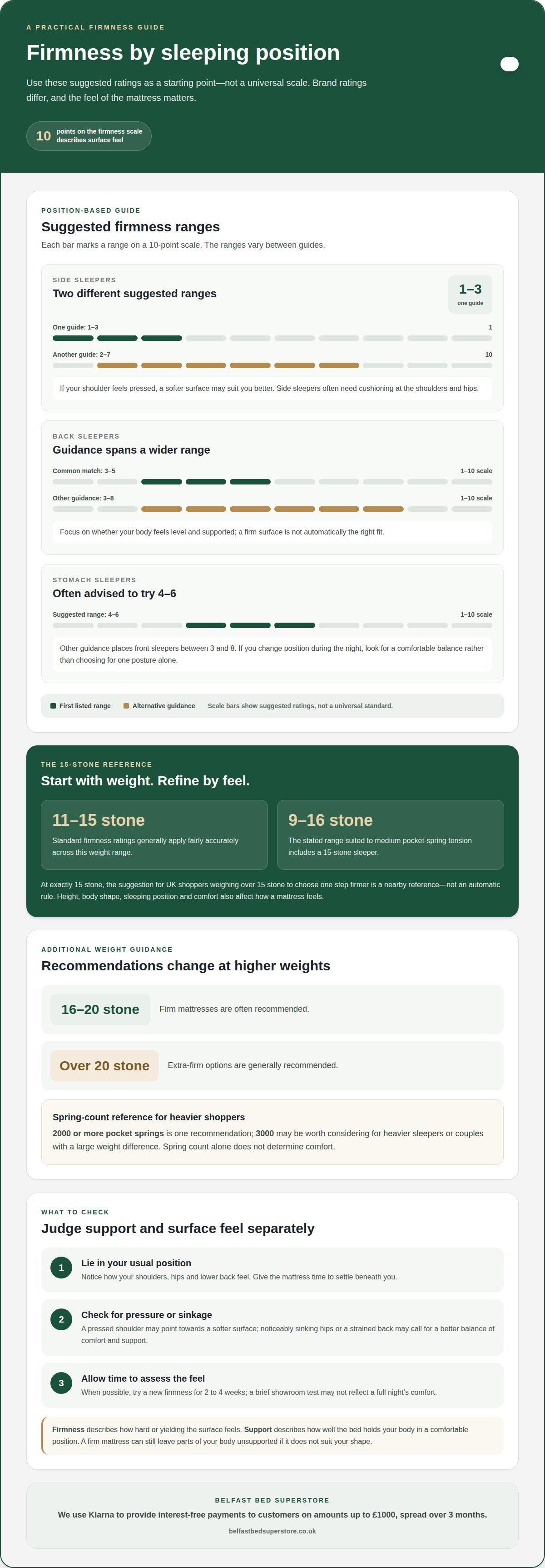
Firmness recommendation for average-weight sleepers
Weight ranges offer a useful starting point, but they don’t determine comfort on their own. At 15 stone, you fall within a commonly used average-weight category, so sleeping position and how the mattress feels still matter.
Firmness Advice by Body Weight
Body-weight recommendations group sleepers by how much they compress a mattress, helping narrow down a suitable firmness. One broad category covers people from 130 to 230 lb, with an upper limit of 16.4 stone or 104 kg. A 15-stone sleeper falls within that range, though a person’s shape and sleeping position can change how the same mattress feels.
Guidance for average-weight sleepers varies: some recommendations place them around firmness ratings 3 to 4, while others suggest levels 4 to 6 for gentle contouring. These ranges aren’t a contradiction so much as a reminder that labels and comfort differ. A stomach sleeper may need a steadier feel than someone who sleeps on their side.
Weight also helps distinguish the average range from lighter guidance. Soft mattresses are often associated with sleepers around 12 stone or less, while lighter sleepers may prefer softer surfaces because they sink less. At 15 stone, a mattress intended for lighter bodies could feel too yielding, particularly if your middle sinks more than the rest of you.
Firmness Scales and Weight Ranges
A 10-point firmness scale describes surface feel, not a fixed weight limit. Recommendations of 4 to 6 for average-weight sleepers can overlap with other ranges, so use the number as a comparison tool rather than a precise measurement. If one mattress rated 5 feels more supportive than another rated 6, compare the construction and your comfort, not the number alone.
Spring tension uses a different guide from a mattress firmness score. Medium pocket-spring tension is recommended for people weighing 9 - 16 stone, which includes a 15-stone sleeper. This can help narrow spring options, but the comfort layers above the springs also affect whether the bed feels too firm or too soft.
For couples with different body weights, one firmness level can feel supportive to one person but uncomfortable to the other. Split or dual-tension designs provide a different feel on each side. For example, the lighter partner may prefer more cushioning while the heavier partner seeks a steadier surface, helping both find a comfortable position without compromising their individual preferences.
Memory foam can add contouring over a spring base, changing the surface sensation without changing your weight. If spinal comfort is a concern, assess whether your body feels level in your usual position. The right choice balances the mattress’s response, your weight and the pressure you feel at contact points.
Firmness ratings varying between brands
A firmness rating helps describe how a mattress feels, but the same number can feel different across brands. Treat the rating as a guide, then compare how the mattress feels under your body and in your usual sleeping position.
This matters at 15 stone because a number alone can’t show how much you’ll sink into a particular design. One brand’s 6 may feel firmer than another brand’s 6, depending on its spring tension and comfort layers. So, if two mattresses share a rating, don’t assume they’ll offer identical comfort or support.
Why the Same Rating Can Feel Different
A 10-point scale appears simple, but its labels don’t create a universal measure between brands. For example, firm mattresses may be described as rating 7.5 to 9 out of 10, while another guide places them at 8 to 10. Medium-firm is also described as 6.5 to 7.5. Those overlapping ranges show why a firmness level needs context.
Construction also changes how a mattress feels. A spring mattress with firmer tension may feel more resistant, while a cushioning comfort layer can soften your first impression. A soft mattress may feel especially yielding to a heavier sleeper, but less so to a lighter person. The rating alone doesn’t explain these differences.
Compare Feel, Not Just Numbers
Use the rating to shortlist options, not to make your final decision. Lie in your usual position and notice whether your hips and shoulders feel comfortable. Side sleepers may feel pressure at those points on a firmer surface; back or stomach sleepers may prefer a steadier feel. These sensations are more useful than comparing labels in isolation.
For example, if one mattress rated 6 feels comfortable on your side, but another rated 6 feels too firm, trust what your body tells you. A difference in upholstery, spring response or surface cushioning may explain the contrast. The useful question is whether the mattress feels balanced, not which label sounds more suitable.
Use Ratings as a Starting Point
When comparing mattresses, keep your sleeping position and preferred feel consistent. Consider whether the surface lets your body settle comfortably, then compare similar constructions where possible. A rating can narrow your choices, but trying a mattress in a showroom gives you a clearer sense of its feel.
If you’re unsure between two firmness levels, focus on the problem you’re trying to solve. A side sleeper who feels pressure may prefer more cushioning; someone whose middle sinks may want a firmer-feeling option. At 15 stone, compare the full mattress experience rather than assuming every brand uses firmness numbers in the same way.
Belfast Bed Superstore
Belfast Bed Superstore offers a range of mattresses to help you compare comfort and firmness beyond the rating label. Hypnos, Sealy, Relyon and Dunlopillo mattresses give you different options to consider alongside your sleeping position and support needs.
If you’re still weighing up what feels right at 15 stone, we can help you focus on the feel and support that matter to you. We use Klarna to provide interest free payments on amounts up to £1000, spread over 3 months.
Contact Belfast Bed Superstore to discuss your mattress options.
Choose a Mattress Feel That Works for You
Choosing a mattress is a personal decision, and the most useful next step is to connect the firmness label with how you actually sleep. If you’re still deciding what firmness is best for a 15 stone person, focus on how your body feels in your usual position, not just the number printed beside a rating. Comfort and support should make sense together for you.
Belfast Bed Superstore offers Hypnos, Sealy and Relyon mattresses, giving you different options to compare by feel. Think about what you want from a mattress, whether that’s a steadier surface, more cushioning or a balance between the two. A clear idea of your preferences can make your next mattress choice more straightforward.
Contact Belfast Bed Superstore to discuss your mattress choice and take the next step towards more comfortable rest.
Frequently Asked Questions
How do I know if my mattress is too soft/too firm?
Notice how your body feels after settling into your usual sleeping position. If your hips sink noticeably or your middle feels unsupported, the mattress may be too soft. If your shoulders or hips feel pressed against the surface, it may be too firm. Repeated morning back pain that eases within an hour of getting up can also suggest your mattress contributes to discomfort.
Firm vs medium firm: which should you choose?
Choose according to how the mattress feels beneath you, not the label alone. Medium-firm to firm mattresses are often recommended for heavier sleepers with back pain, but a very firm surface may feel uncomfortable if it creates pressure. Try both feels in your usual position. Compare whether your body settles evenly and you can relax without excessive sinkage or pressure.
How Do You Choose the Best Mattress for You?
Start with your main sleeping position, then consider which areas need cushioning and which need a steadier feel. Lie on the mattress in your usual posture and give your body time to settle. If you share a bed, consider whether one firmness suits both people or whether split tension would help. Where possible, assess a new mattress over 2 to 4 weeks.
What Firmness Should You Choose?
Use your sleeping position and body weight together to narrow your options. Side sleepers often need cushioning around the shoulders and hips, while back or stomach sleepers may prefer a steadier surface. Then judge the mattress by how your body rests on it, rather than choosing the highest firmness rating. If you change positions during the night, look for a comfortable middle ground.
What is a comfort/firmness rating?
A comfort or firmness rating is a guide to how soft or firm a mattress may feel. On a 10-point scale, medium-firm is commonly placed around 6.5 to 7.5, while firm ratings are often around 8 to 10. These ranges can overlap or differ between brands, so use the number to compare options within a range, not as a guarantee of identical feel.
What mattress firmness is best for a 15-stone person?
For a 15-stone sleeper, medium pocket-spring tension is a reasonable starting point because the recommended range is 9 - 16 stone. Your sleeping position still influences the surface feel you may prefer. If you sleep on your side, pay attention to shoulder and hip pressure; if you sleep on your back or front, notice whether your middle feels supported.
What mattress firmness is recommended by weight in the UK?
UK guidance often groups sleepers under 130 lb, or 9.2 stone or 59 kg, as lighter sleepers. An average-weight category runs from 130 to 230 lb, with an upper limit of 16.4 stone or 104 kg. Recommendations vary across guides and brands, so combine weight with sleeping position and how the mattress feels beneath your body.
Is medium-firm or firm better for a 15-stone side sleeper?
Medium-firm can be a sensible starting point, but the better choice depends on pressure and support. A firm surface may feel uncomfortable if your shoulder or hip presses into it; a softer-feeling option may ease that pressure. Compare both in your usual side-sleeping position and notice whether your body feels supported without excessive sinkage. Brand ratings can differ, so judge the feel directly.