
 Buy now, Pay later

Extra long single beds for taller sleepers
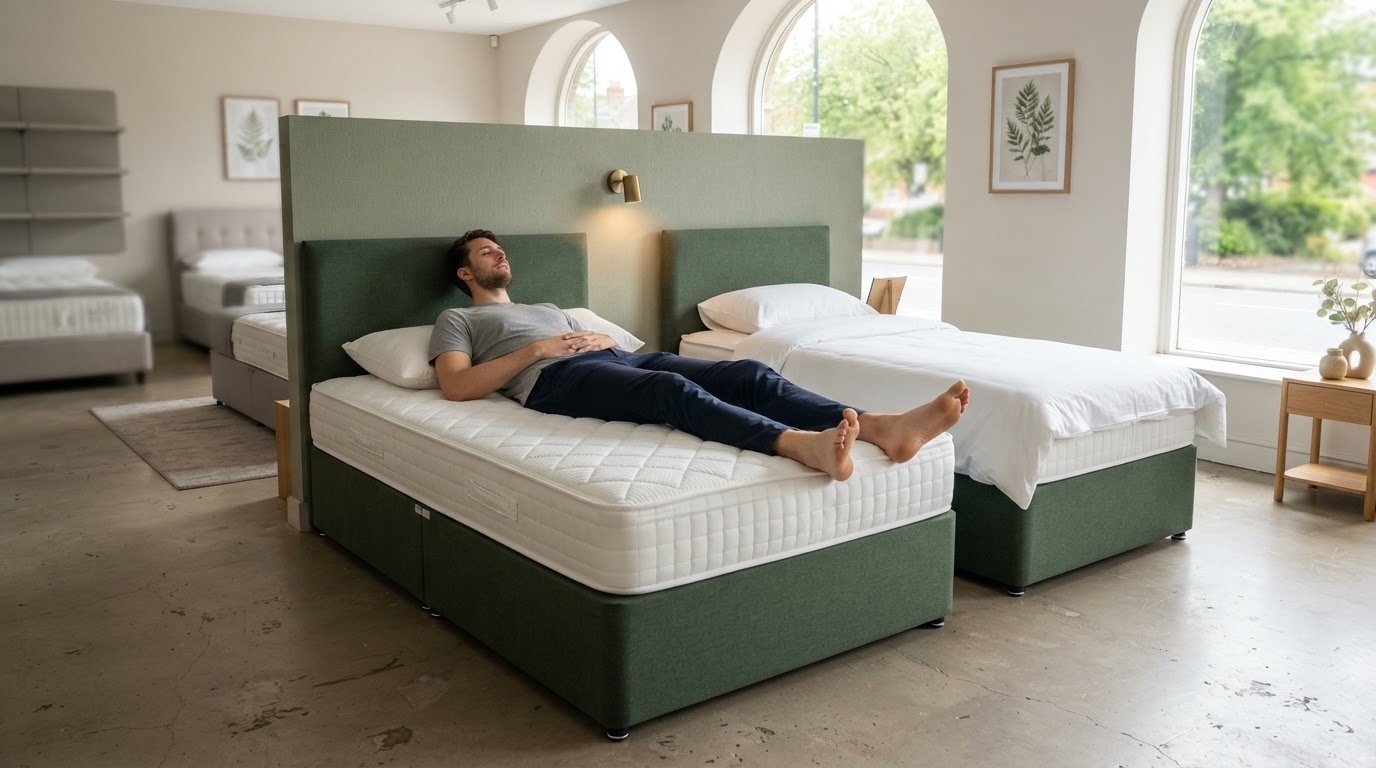
A single bed doesn’t have to stop at the standard length. In the UK, a standard single measures 90cm x 190cm, while extra-long single options measure 90cm x 200cm or 90cm x 206cm. For a tall sleeper, an extra long single bed for a tall person can provide more room to stretch out without taking up the width of a larger bed.
If your feet reach the end of the mattress or you find yourself sleeping curled up, the bed may simply be too short. A useful guide is to choose a mattress around 10-15cm longer than your height, so the right length depends on how tall you are and how much room you like around your feet.
This guide explains how an extra-long single bed for a tall person compares with a standard UK single, how to choose a suitable mattress length, and what to measure in your bedroom before buying. You’ll also find practical tips for checking the delivery route, including doorways, stairs and tight turns, so the bed can reach its intended place.
Key Takeaways
- Compare the standard UK single at 90cm x 190cm with extra-long options at 90cm x 200cm or 90cm x 206cm.
- Choose a mattress around 10-15cm longer than the sleeper’s height for extra room to stretch out.
- Consider whether a high or padded foot end could make the bed feel more restrictive.
- Measure the full bed frame, not just the mattress, and allow for the space needed to move it into the bedroom.
- Check the room layout and delivery route, including tight turns and any clearance needed for an opening ottoman bed.
What size are long beds?
An extra-long single keeps the familiar single-bed width but adds length. Compare the mattress dimensions, not just the bed’s label, before choosing.
Extra-Long Single and Double Dimensions
An extra-long single is typically 90cm wide, with lengths of 200cm or 206cm. That gives 10cm or 16cm more room than a standard 90cm x 190cm single. The extra length can help you stretch without using the wider footprint of a double.
Extra-long doubles are typically 135cm wide and come in 200cm or 206cm lengths. Check both measurements: a longer mattress won’t provide extra width, and the bed base should match its length. These dimensions describe the mattress, so allow for the frame when planning space.
Standard Single and Long Bed Dimensions
A standard UK single mattress measures 90cm wide by 190cm long. A double bed generally offers more width than a single, rather than extra legroom. King size mattresses are typically 200cm long, while extra-long single beds reach the same length or extend to 206cm.
“Long bed” can refer to different lengths, so look for the mattress measurement in centimetres. A 200cm single and a 206cm single are both longer than the standard 190cm size, but they don’t offer the same amount of stretch. Check that the base and mattress share the same length.
UK Long Single Length and Sleeper Suitability
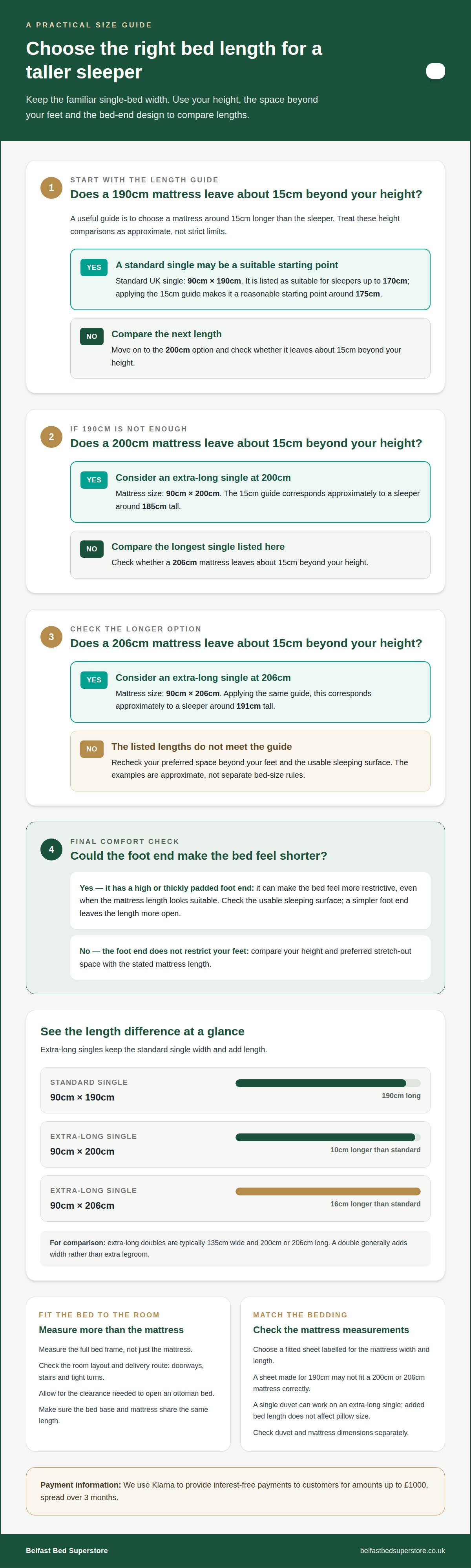
A UK long single mattress is available at 200cm or 206cm long, and both are typically 90cm wide. A standard single is listed as suitable for sleepers up to 170cm tall; a useful guide is choosing a mattress around 15cm longer than the sleeper.
Using that guide, a 200cm mattress may suit someone around 185cm tall, while a 206cm mattress may suit someone around 191cm tall. These are approximate comparisons, not separate bed-size rules. For an extra long single bed for a tall person, compare the mattress length with your height and preferred space beyond your feet.
Bedding for Extra-Long Singles
A single duvet can work on an extra-long single bed, and the added length does not affect pillow size. You can usually keep using your existing pillows and pillowcases. Check the duvet and mattress dimensions separately: the duvet covers you, while the mattress needs to fit the bed.
For a fitted sheet, match its stated mattress dimensions to the bed’s width and length. A sheet made for a 190cm mattress may not fit a 200cm or 206cm mattress correctly. Check the bedding label for the measurements, especially the length, before buying; this helps the sheet sit securely across the full mattress.
Recommended sleeper heights for each length
A practical guide is to choose a mattress around 15cm longer than the sleeper’s height. That leaves space beyond the feet, rather than matching mattress length exactly to body height. In the UK, standard beds up to double size are around 190cm long, while king-size and larger beds are around 200cm.
Use mattress length as your starting point, then consider how you sleep. If you lie fully stretched, you may want more spare room than someone who sleeps curled up. Check the stated mattress length rather than relying only on labels such as single, double or king size.
- 190cm: A standard UK single is listed as suitable for sleepers up to 170cm tall. The 15cm guide also makes a 190cm mattress a reasonable starting point for someone around 175cm tall.
- 200cm: This length gives more room than a standard bed and aligns with the approximate 15cm allowance for a sleeper around 185cm tall.
- 206cm: The longer option allows more space beyond the feet. Applying the same guide, it corresponds to a sleeper around 191cm tall.
These examples apply the same length rule, but they are not strict height limits. Comfort, sleeping position and the bed’s end design all affect usable space. A high or thickly padded foot end can make a bed feel more restrictive, even when the mattress length looks suitable.
Choosing bed length for your height
Start with your height, then add roughly 15cm to estimate a comfortable mattress length. For example, a person who is 6ft 4in needs a bed at least 6ft 8in long. Compare that requirement with the mattress measurement, not just the frame’s advertised category.
Consider how you stretch out at night. If your feet reach a raised footboard, you may need more usable length than the mattress measurement alone suggests. The type of mattress, including sprung or pocket-sprung, does not change the length you need, so focus on the sleeping surface.
Average UK bed lengths
Many UK beds up to double size are around 190cm long. King-size and super king-size mattresses are described as 200cm long, offering an extra-length option without moving to a wider bed.
Check that your bedding suits the mattress dimensions. Duvets and fitted sheets need to fit the mattress, while pillows are not affected by bed length. Matching your height and sleeping position to the mattress length can help you avoid choosing a wider bed when extra length is what you need.
Extra legroom for taller sleepers
For sleepers over 6ft, bed length can affect how freely they stretch out. A mattress longer than the standard 190cm is usually more comfortable for someone around 6ft 3in. Extra space beyond the feet helps avoid feeling pressed against the end of the bed. The right choice also depends on the bed’s design, not only its stated mattress length.
Check the usable sleeping surface from the head end to the foot end. A high footboard or thickly padded end can make a mattress feel more restrictive to taller sleepers. For example, a 200cm mattress may feel less spacious if a raised bed end limits where your feet can rest. A simpler foot end leaves the length more open.
Before choosing a frame, consider these practical points:
- Measure your sleeping position: Lie fully stretched and note whether your feet reach the mattress edge. Compare that position with 190cm, 200cm and 206cm mattress lengths.
- Look beyond the headline length: Check whether the frame’s headboard or footboard changes the usable space. A thick finish at the foot may feel more enclosing than an open design.
- Consider the surface: Fabric upholstery can add padding to a frame’s ends. A clean-lined finish may leave the mattress edge easier to use.
- Separate storage from sleeping length: Drawers beneath the bed affect storage access, not mattress length. Check that drawer fronts or handles won’t obstruct movement around the bed.
Extra length can make a noticeable difference without requiring a wider mattress. A 90cm-wide single at 200cm or 206cm gives taller sleepers more length while keeping the single-bed footprint. The best match depends on your height, how much room you want beyond your feet, and whether the frame has a solid or padded end.
For a simple comparison, picture someone 6ft 3in tall choosing between a standard 190cm mattress and a longer option. The standard length may leave little spare room, while 200cm or 206cm provides more space to stretch. Check the mattress measurement and foot-end design together, especially if you sleep flat rather than curled up.
The frame’s finish and fabric affect its look and feel, but its design can also affect usable space. A padded footboard may look soft and substantial, yet its thickness can make the bed feel more enclosed. If legroom is your priority, choose a design that leaves the mattress end clear and makes the full sleeping surface easy to use.
Measuring bedroom space and delivery access
Measure the complete bed, not just the mattress. A bed frame can add several centimetres on each side, so a 90cm-wide mattress needs more room once it sits within its frame. Allow space for movement around the bed and access to wardrobes, drawers and the bedroom door.
Use the mattress dimensions as your starting point, then measure the frame and the room separately. For example, a 200cm mattress does not mean the assembled bed is exactly 200cm long. Divan bases and bedsteads can have different external dimensions, so use the specific bed’s measurements when planning its position.
A practical measuring sequence can help you spot tight spaces before delivery:
- Mark the floor area: Use the frame’s full width and length, including any headboard or footboard. Check whether the bed blocks a wardrobe, radiator or route across the bedroom.
- Measure the access route: Record the clear width and height of doorways, hallways and staircases. Include narrow turns and landings, where a long or bulky component may need to be angled.
- Check fixed obstacles: Note door swings, low ceilings, banisters and light fittings. A clear doorway alone doesn’t show whether a bed component can pass around a tight corner.
- Plan the final position: Leave enough room to make the bed and move around it. A super king footprint can help illustrate how width affects circulation, even when you’re planning a single.
- Compare the measurements: Match the mattress, base and frame dimensions. Keep the figures together so the bedroom layout and delivery route can be considered as one plan.
The mattress material does not replace the need to check the fit. A memory foam mattress still needs a correctly sized base and a clear route into the room. A pillow does not change the bed’s footprint, but leave enough bedside space to reach it comfortably.
Consider how the bed opens, too. An ottoman bed needs clearance at the foot when its storage is raised. Measure the space in front of the bed and account for nearby furniture, rather than checking only whether the closed frame fits.
For a long single, the room’s usable length matters as much as its width. Measure from the wall to the nearest obstacle, including the space you need to walk past the foot of the bed. This helps you check both that the bed fits the bedroom and that it can be moved into position.
Comparison with standard UK single sizes
A UK long single keeps the standard single width but adds length. A European mattress is 200cm long across widths, while “super single” needs a width and length measurement to make the comparison clear.
Standard UK Single Size Comparison
A standard UK single mattress measures 90cm x 190cm. Extra-long singles measure 90cm x 200cm or 90cm x 206cm, keeping the same width while adding 10cm or 16cm in length. An extra-long double is wider at 135cm, with 200cm or 206cm lengths. Compare both dimensions before choosing.
A frame can extend beyond the mattress on each side. Check its external measurements too, particularly if a headboard or foot end affects the available floor space.
Long, European, and Super Single Differences
A long UK single is typically 90cm wide and 200cm or 206cm long. European mattresses are 200cm long across all widths, so their width distinguishes one size from another. “Super single” does not identify a measurement in the figures used here. Compare the actual mattress width and length rather than relying on that label.
Names can make sizes sound closer than they are. A European mattress measuring 200cm long may share the length of one long UK single, but not necessarily its width. Check the measurements printed for both mattress and base.
That width comparison is the useful takeaway. A taller sleeper who wants to keep a single-bed footprint can focus on a 90cm-wide long single. Someone needing more sleeping width can compare the 135cm extra-long double, while remembering that it takes more room across the bedroom.
Use this quick comparison when reviewing bed designs:
- Standard UK single: 90cm wide and 190cm long.
- Extra-long UK single: 90cm wide and either 200cm or 206cm long.
- Extra-long UK double: 135cm wide and either 200cm or 206cm long.
- European mattress: 200cm long, with width varying by size.
Check dimensions carefully if the mattress and frame use different sizing systems. Match their measurements and allow for the frame’s extra width or length. Include the headboard when planning where the bed will sit, as it can affect the total footprint. These checks help distinguish a genuinely longer single from a wider design with a similar name.
Belfast Bed Superstore
At Belfast Bed Superstore, you can explore mattress and bed options once you’ve worked out the length and space you need. If you’re comparing an extra-long single with a wider bed, consider your preferred sleeping space, the mattress dimensions and how the frame will fit your room. You can also explore Hypnos, Sealy, Relyon and Dunlopillo mattresses as part of your decision.
Bring your measurements and the bed size you’re considering into the conversation. We can help you think through the mattress choice alongside the room layout, so you can make a considered decision about comfort and fit. If you’d like guidance with your options, please contact Belfast Bed Superstore.
Make your next bed choice with confidence
Your measurements are a useful starting point, but the bed should also suit your everyday routine. Think about how you sleep, how much room you want around the bed and which mattress feel you prefer. Choosing an extra-long single bed for a tall person means bringing those practical details together, not simply picking the longest option.
Belfast Bed Superstore offers Hypnos, Sealy and Relyon mattresses to consider as part of your bedroom plans. Bring your preferred bed dimensions and room measurements into the decision, then focus on the comfort and support that feel right for you.
Contact Belfast Bed Superstore to talk through your next step. With a clear idea of what you need, you can move towards a bed that makes your space feel more comfortable and restful.
Frequently Asked Questions
Why do tall people need longer-length beds?
Extra length gives your feet room to rest without pressing against the mattress edge or footboard. On a shorter bed, you may bend your knees or shift position to fit. Someone who sleeps flat on their back, for example, may notice limited foot space more than someone who sleeps curled up. Consider your natural sleeping position as well as your height.
Can You Get a Custom Size Mattress?
Custom-sized mattresses can be made in non-standard lengths and widths. If you need a less common size, write down both the required width and length before choosing. The base must match those dimensions too. Custom sizing can help when a room or existing bed frame calls for measurements outside familiar UK sizes.
Can You Get an Extra Long Bed or Mattress in Ireland?
Extra-long bed options are available in Ireland, and custom-sized mattresses can include non-standard lengths and widths. Check whether a measurement describes the mattress or the complete bed, as the frame can extend beyond the mattress. Width matters too, especially if the bed needs to fit in a smaller bedroom.
How long is the average bed?
In the UK, beds up to double size are typically around 190cm long; king-size beds and larger are around 200cm. These are useful comparisons, not a substitute for checking the dimensions of a particular mattress. For example, a standard double and a standard single share the same typical length, despite their different widths.
How long should my bed be for my height?
A useful guide is to choose a mattress around 15cm longer than your height. This gives your feet some room beyond your body when you lie flat. For example, a 200cm mattress corresponds to someone around 185cm tall using that guide. Treat the calculation as a starting point, then consider your sleeping position and how much space you prefer.
What About the Bed Base?
The bed base should match the mattress length. A longer mattress needs a base designed for that length, not a standard base that leaves it unsupported. Check the stated mattress and base dimensions before ordering. Also account for the frame’s external size when planning the bed’s position, as its footprint can exceed the sleeping surface.
What Is the Standard Mattress Length?
A standard UK single mattress is 190cm long, and a standard UK double mattress is also 190cm long. UK king-size mattresses are typically 200cm long. These measurements make it easier to see whether you need more length or simply more width. Check the mattress label or product dimensions, rather than assuming every bed in a named size is identical.
What styles of long beds are available?
Bed styles include divan beds, ottoman beds, wooden bedsteads, metal bedsteads, upholstered bedsteads and adjustable beds. The style affects features such as storage, appearance and how the base is constructed; it doesn’t by itself tell you the mattress length. We use Klarna to provide interest free payments on amounts up to £1000, spread over 3 months.